A Century After the Flames: Remembering the Pavilion Fire of 1926
The Pavilion’s ongoing restoration marks 100 years since the fire that nearly destroyed it, honouring the resilience and community spirit that secured its future.
August 21, 2026
.png)
In the early hours of 21st August 1926, while most of Selsey slept, flames climbed through the roof of the town’s Pavilion. Only hours earlier, the building had echoed with music and laughter as the concert party Delight entertained holidaymakers and a dance organised by Selsey Golf Club continued into the night. Shortly after 4.20 am, that celebration gave way to disaster when fire took hold of one of the town’s most important community buildings.
A century later, the Pavilion is again at a pivotal point in its history. With restoration work under way, the fire’s centenary offers an opportunity both to revisit one of the building’s darkest hours and to celebrate the resilience that carried it through. This is more than the story of a single night of destruction. It is the story of a community responding to crisis, of recovery in the face of loss, and of a landmark whose place in Selsey proved stronger than the flames that threatened to destroy it.
The Heart of a Community
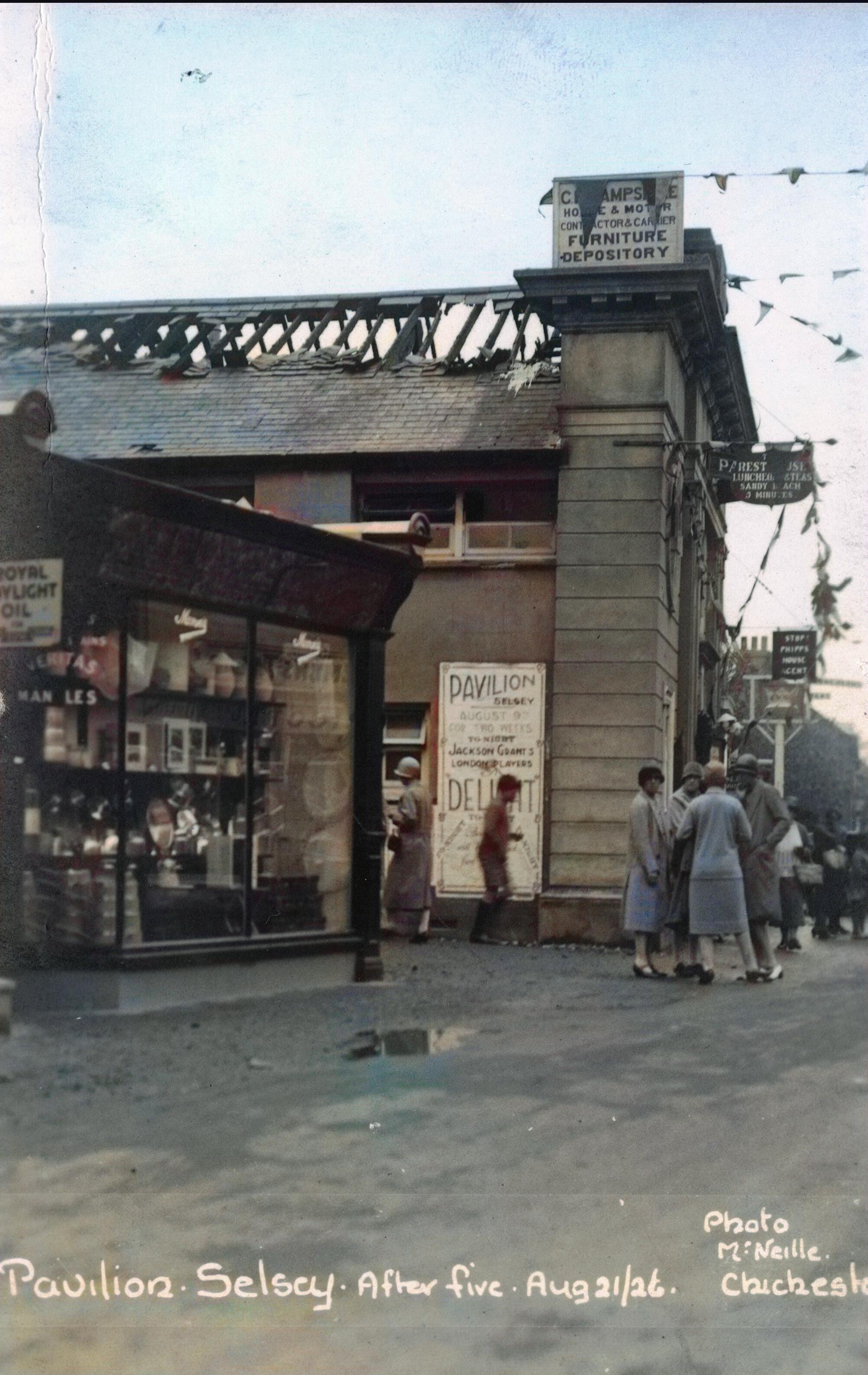
Long before the fire, the Pavilion stood at the heart of life in Selsey. In the 1920s, it was far more than a theatre or cinema: it hosted concerts, dances, meetings, exhibitions and charitable events for residents and visitors alike. During the busy summer season, it ranked among the town’s principal attractions, a role that made the events of August 1926 all the more devastating.
Its programme brought people together across generations and gave Selsey a shared place for entertainment, celebration and public life. For holidaymakers it was part of the town’s appeal; for residents it was a familiar meeting place woven into the rhythm of the year. The threat to the Pavilion was therefore felt not simply as damage to a building, but as a blow to the social life and identity of the community.
A Night That Changed Everything
During the early hours of Saturday 21 August 1926, shortly after 4.20am, Mr Hobden of High Street was making his way home when he spotted flames shooting through the Pavilion’s roof. He immediately alerted the building’s owner, F. W. Phipps, who lived nearby. Within minutes, Phipps and local musicians and residents rushed to the scene.
Among the first to respond was Clifford Smith, the jazz drummer who had been performing at the dance only hours earlier. Smith and Phipps fetched the firefighting equipment and began battling the blaze themselves. Working amid falling slates, burning timber and a continual rain of debris from the roof, they attacked the fire before the arrival of the Chichester Fire Brigade under Captain Hooper. Contemporary newspapers praised their efforts, noting that their quick action helped prevent the adjoining theatre from becoming involved. Despite serious damage to the balcony, roof and auditorium, much of the building was saved.
The Mystery of the Fire
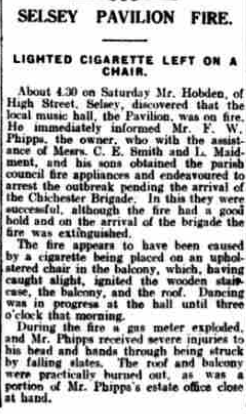
Although no definitive cause was ever established, contemporary reports suggested that a lighted cigarette had been left on an upholstered chair in the balcony area, which served as a gentlemen’s cloakroom during dances. Reporters believed the cigarette ignited the padded seat before the flames spread into the wooden structure beneath the seating. The blaze rapidly consumed parts of the balcony and roof, while an exploding gas meter added to the danger.
During the effort to save the building, Mr Phipps suffered injuries to his head and hands from falling rubble but continued helping to fight the fire. The newspaper accounts offer a plausible explanation, but they stop short of recording a conclusive official finding. That uncertainty leaves a small but important gap in the story: the fire’s probable origin can be reconstructed from contemporary reporting, yet the precise sequence by which it took hold remains unresolved a century later.
From Disaster to Recovery
The timing could hardly have been worse: the fire struck at the height of the summer season. The balcony, roof and portions of the auditorium were badly affected. The rear of the theatre and the stage escaped the worst of the destruction, however, and contemporary reports estimated the damage at about £2,000. One newspaper lamented that visitors had lost their ‘chief source of amusement' and expressed sympathy for Mr Phipps, whose livelihood depended on the Pavilion’s operation during the busiest part of the year. Yet the building survived. Repaired and reopened within months, it went on serving successive generations of Selsey residents. Remarkably, traces of the blaze remain visible inside the Pavilion today, providing a tangible link to that dramatic night a century ago.
Then and Now
What makes the story especially resonant is how closely it echoes the present. In 1926, local people rallied to save a building they considered vital to their community. A century later, volunteers, supporters and restoration specialists are working with the same sense of purpose.
Then, the immediate task was to prevent flames from consuming the Pavilion; today, the challenge is to conserve its historic fabric and return it to lasting use. In both moments, the building’s future has depended upon people recognising its value and choosing to act. The restoration continues that tradition of stewardship, ensuring that the Pavilion can remain a place of shared experience for generations still to come.
The centenary is therefore more than an anniversary of disaster; it is a celebration of survival, community spirit and renewal. One hundred years after flames threatened its future, the Pavilion stands once more as a symbol of resilience, and its story is still being written.
*This article draws on newspaper reports published in August 1926 alongside Pavilion records and restoration research.
Don't miss a thing – sign up to our newsletter!
.jpg)
Support Us
Please support our efforts with a one-off donation. 100% of the donation goes to the charity. You can choose how much you want to donate, Gift Aid, and remain anonymous. It's a fast, flexible way of supporting our ongoing efforts.
Proudly supported by


Quick Links
Contact us
Join our 'Friends Of' Newsletter


